 vCIO Overview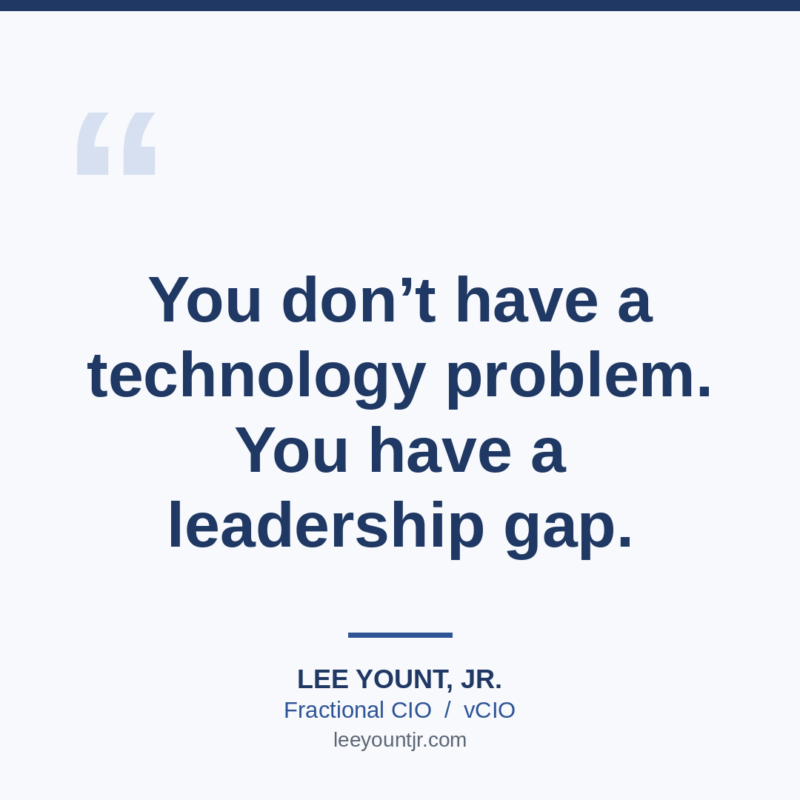
Your network is up. Email is flowing. When a laptop dies or the Wi-Fi drops, you call your IT person and it gets handled. By every visible measure, your technology is under control.
So why does every real technology decision still land on your desk — and why does making it feel like a guess? There’s a name for the role that answers that question — a Fractional CIO — and most growing businesses don’t have one.
Here’s the uncomfortable truth most growing businesses never get told: keeping technology running and deciding where it should take your business are two completely different jobs. Most small and mid-size companies have the first one covered and the second one sitting empty. And the gap stays invisible — right up until the day it isn’t. Did someone say Fractional CIO?
What is a fractional CIO? A fractional CIO — also called a virtual CIO or vCIO — is a senior technology executive who sets and owns your IT strategy on a part-time basis, giving you the roadmap, vendor leverage, and risk oversight of a full-time CIO for a fraction of the cost. A fractional CIO works alongside your existing IT provider, not in place of it.
Two different jobs (and most businesses only fill one)
Keeping the lights on is the operational layer. Helpdesk tickets, fixing what breaks, patching, backups, password resets, swapping the dead laptop. This is what your managed service provider (MSP) or in-house IT person does, and a good one is worth every penny. But look closely at what that work is: it’s reactive. It answers exactly one question — “Is it working right now?”
Steering the ship is the strategic layer, and it answers a completely different question — “Are we doing the right things, for the right reasons, in the right order?” Where is the business going, and how should technology get it there? What do we invest in, and what do we deliberately not spend money on? What does the three-year roadmap look like? Are we actually secure, or just lucky so far? Are we paying for the right tools — or just the ones a salesperson got to us first?
That second job is the CIO’s job. And here’s the thing:
Your MSP keeps the car running beautifully. It doesn’t decide where you’re driving — or whether you should’ve taken a different road entirely.
An MSP answers “is it working?” A CIO answers “are we working on the right things?” You need both. Most companies only have one.
The gap is invisible — until the day it isn’t
You won’t feel the absence of strategic technology leadership on a normal Tuesday. You’ll feel it on the day a decision lands that’s bigger than break-fix can handle:
- A vendor pushes a five-figure renewal across your desk, and you have no idea whether it’s a fair deal or a fleecing.
- You’re acquiring another company (or being acquired), and suddenly two sets of systems have to become one.
- Someone clicks the wrong email, and you discover that “I hope we’re backed up” is not, in fact, a plan. (backups and an incident response plan – What CISA says about it)
- Everyone’s asking about AI, and you genuinely can’t tell if it’s a real opportunity for your business or just noise. (whether AI is a real opportunity for your business – SBA’s take)
- You’re growing, and the systems that ran fine at 15 employees are buckling at 60.
These are the moments the bill for a missing CIO comes due. And it almost always arrives mid-crisis, mid-purchase, or mid-audit — which is the worst possible time to start thinking strategically.
A quick gut check: do you have the gap?
You’ve got operations covered but strategy missing if more than a couple of these sound familiar:
- Your technology spending is mostly reactive — you buy when something breaks or when a salesperson catches you, not from a plan.
- Nobody actually manages your IT provider. They send invoices, you pay them, and no one is holding them to real outcomes.
- You — the owner — are making technology calls you’re not really equipped to make, because there’s no one else to make them.
- You couldn’t describe your technology roadmap for the next two years, because there isn’t one.
- Your honest answer about cybersecurity is “I think we’re okay?”
- Every tool was chosen in isolation, and now nothing talks to anything.
If three or more of those land, here’s the reframe: you don’t have a technology problem. You have a leadership gap.
What that gap actually costs you
This isn’t abstract hand-wringing. A missing strategy shows up as real money walking out the door:
- You overpay vendors nobody’s negotiating with.
- You buy the wrong system because nobody evaluated it against the business — then pay a second time to fix it.
- You spend reactively, and emergencies always cost a premium, instead of proactively, where planned work is cheaper.
- You miss the efficiency gains and revenue opportunities a strategist would have spotted a mile away.
The most expensive technology decisions a small business makes are the ones nobody was actually in charge of.
Let me make that concrete with my own work. Steering the ship has meant things like building a reporting dashboard in-house instead of buying an off-the-shelf product — saving $80,000 a year — and moving a company’s online store onto the right platform, saving another $50,000 a year. Neither of those was a “fix it” decision. Both were “wait — should we even be doing it this way?” decisions. That’s the difference strategy makes, and it’s the difference an operational IT layer was never designed to deliver.
Enter the Fractional CIO
Here’s the catch every owner runs into: a full-time CIO is a six-figure hire that most small and mid-size businesses simply can’t justify. So the strategic seat just stays empty, and the owner keeps absorbing decisions they shouldn’t have to.
A fractional (or virtual) CIO fills that seat part-time. You get senior technology leadership — the roadmap, the vendor leverage, the risk oversight, the “should we?” judgment — for a few hours or days a month, scaled to your budget. You pay for the strategy, not a full-time salary.
In practice, that looks like a technology roadmap tied to your actual business goals; a steady hand in the room when the big decisions and vendor renewals come up; regular reviews of where your money’s going and whether it’s working; and one person who finally owns the question “is our technology serving the business?”
“But I already have an IT company.”
Good. Keep them. This is the part people get backwards.
A vCIO (Fractional CIO) doesn’t replace your IT provider — we work alongside them. Your MSP executes the how; the Fractional CIO owns the what and the why. They keep the lights on; I make sure the building is headed somewhere worth going. Done right, a Fractional CIO actually makes your existing IT company more valuable to you, because someone is finally translating between what they’re doing and what the business needs.
A good vCIO (Fractional CIO) doesn’t compete with your IT company. They make your IT company make sense.
And if you’re an MSP or IT services firm reading this — that’s a role I can play for you. Plenty of your growing clients are asking for strategic guidance you may not have the bandwidth, or the appetite, to staff with a full-time executive. I can be the client-facing vCIO (Fractional CIO) on your behalf: running the assessments, building the roadmaps, leading the quarterly business reviews, and being the trusted strategic voice your clients want — while your team keeps doing what it does best. It makes your clients stickier and your offering more complete, without putting another salary on your books. (If that’s interesting, let’s talk about a partnership.)
Frequently Asked Questions About Fractional CIOs
What is a fractional CIO?
A fractional CIO is a senior technology leader who provides CIO-level strategy — roadmap, budgeting, vendor management, and cybersecurity oversight — on a part-time basis. The role is also called a virtual CIO or vCIO. You get executive technology leadership scaled to your needs and budget, without a full-time six-figure salary.
What’s the difference between a fractional CIO and an MSP?
An MSP (managed service provider) keeps your technology running — help desk, fixes, patching, and backups. A fractional CIO decides where your technology should go: strategy, roadmap, investments, and risk. The MSP owns the “how”; the fractional CIO owns the “what” and “why.” Most growing businesses need both.
How much does a fractional CIO cost?
Far less than a full-time CIO, which is typically a six-figure salary. A fractional CIO is billed for a few hours or days a month, scaled to your budget, so you pay for the strategy rather than carrying a full-time executive on payroll.
Is a fractional CIO the same as a vCIO?
Yes. “Fractional CIO” and “virtual CIO (vCIO)” describe the same role: part-time, senior technology leadership. The terms are used interchangeably.
When does a business need a fractional CIO?
Common triggers include reactive break-fix technology spending, no two-to-three-year technology roadmap, no one holding your IT provider accountable, uncertainty about cybersecurity, a merger or acquisition, rapid growth straining the systems you have, or trying to evaluate whether AI is a real opportunity.
Does a fractional CIO replace my IT company?
No. A fractional CIO works alongside your existing IT provider or MSP. They keep the lights on; the fractional CIO sets the direction and makes sure your technology serves the business.
The Bottom Line
I’ve spent more than twenty years on the strategy side of technology — as a CIO and IT leader across manufacturing, healthcare, and government. I’ve also built and run my own small business, so I know exactly what it feels like when every dollar and every hour has to count. That’s the seat I sit in for the companies I work with: the one looking up at the horizon, not just down at the dashboard.
Keeping the lights on matters. It always will. But lights don’t steer a ship.
If any of this sounded like your business, let’s fix the gap before the next big decision forces the issue. I offer a free 30-minute IT health check — a quick, no-pressure look at where your technology could be saving you money, reducing risk, or opening up room to grow.
